
Federal contractors face increasing scrutiny of employment practices, compensation decisions, and compliance certifications.
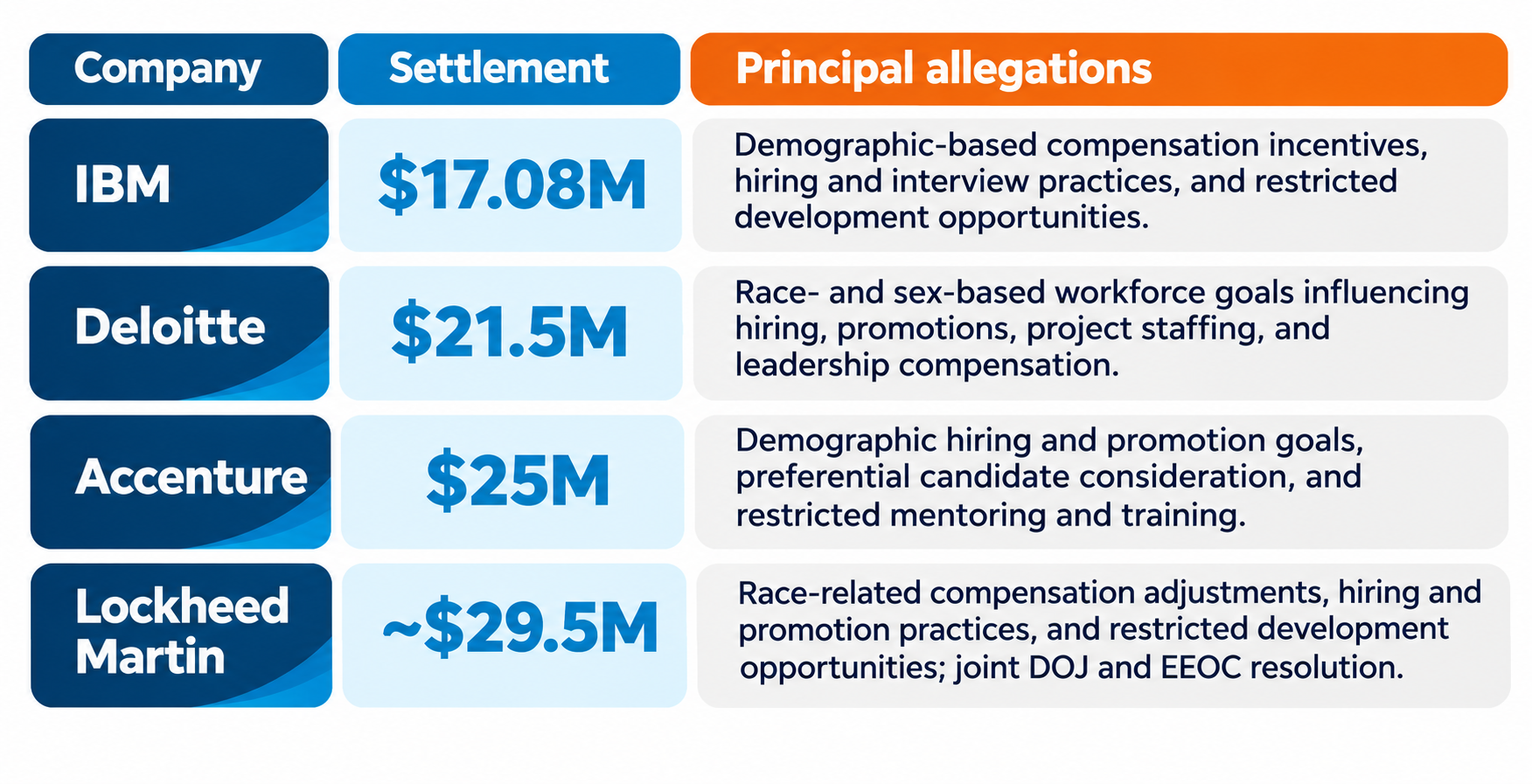
Four major settlements announced since April 2026 illustrate how federal civil rights enforcement can reach beyond individual discrimination complaints into corporate employment systems, management incentives, and federal contracting certifications.
The DOJ’s Civil Rights Fraud Initiative uses the False Claims Act (FCA) to investigate allegations that federal contractors knowingly sought government payments while failing to comply with material contractual nondiscrimination requirements. The EEOC separately enforces Title VII of the Civil Rights Act of 1964, including protections against discriminatory compensation and other employment decisions.
Adding to these enforcement risks are the FCA’s qui tam provisions, which financially incentivize eligible whistleblowers, including current and former employees, as well as qualifying advocacy organizations, to report suspected fraud involving federal contracts.
Eligible whistleblowers may receive 15%–25% of settlements when the government intervenes, or 25%–30% when they successfully pursue cases without government intervention, subject to statutory conditions.
Although discrimination alone does not automatically establish FCA liability, these incentives increase the importance of proactively identifying and correcting potential violations and ensuring accurate compliance certifications.
For federal contractors, the message is clear: Waiting for a whistleblower complaint or government investigation to uncover potentially discriminatory employment practices is a costly risk that proactive workforce monitoring can help mitigate.
The four settlements at a glance
The laws and regulations behind the enforcement actions
Title VII of the Civil Rights Act of 1964 prohibits employment discrimination based on race, color, religion, sex, and national origin. It applies to hiring, promotions, compensation, training, and other terms and conditions of employment.
The False Claims Act, 31 U.S.C. §§ 3729–3733, establishes civil liability for specified knowingly false or fraudulent claims and statements. In the contracting context, the DOJ’s theory in these cases connects alleged discriminatory practices with certifications of compliance and requests for federal payment. Liability is not automatic whenever an employment violation occurs; the FCA’s applicable knowledge, falsity, and materiality requirements still matter.
FAR 52.222-26, Equal Opportunity, is particularly significant. IBM, Deloitte, and Accenture’s agreements identify this contractual provision and Title VII as underlying nondiscrimination requirements. The government alleged that the contractors certified compliance while maintaining discriminatory practices and seeking payment under federal contracts.
Executive Order 14173, issued in January 2025, changed federal contractor affirmative action requirements and introduced additional federal contracting compliance expectations.
Executive Order 14398 and FAR 52.222-90 further address racially discriminatory DEI activities in covered federal contracting. They are relevant to employers reviewing current contract requirements but should not be presented as the original legal basis for every alleged practice in these settlements, many of which began years earlier.
The Equal Pay Act separately prohibits sex-based wage discrimination for substantially equal work, subject to statutory defenses. It remains relevant to compensation diagnostics even though these four settlements were not presented as Equal Pay Act resolutions.
What makes the Lockheed Martin case particularly significant?
The November 3 settlement combined two enforcement mechanisms:
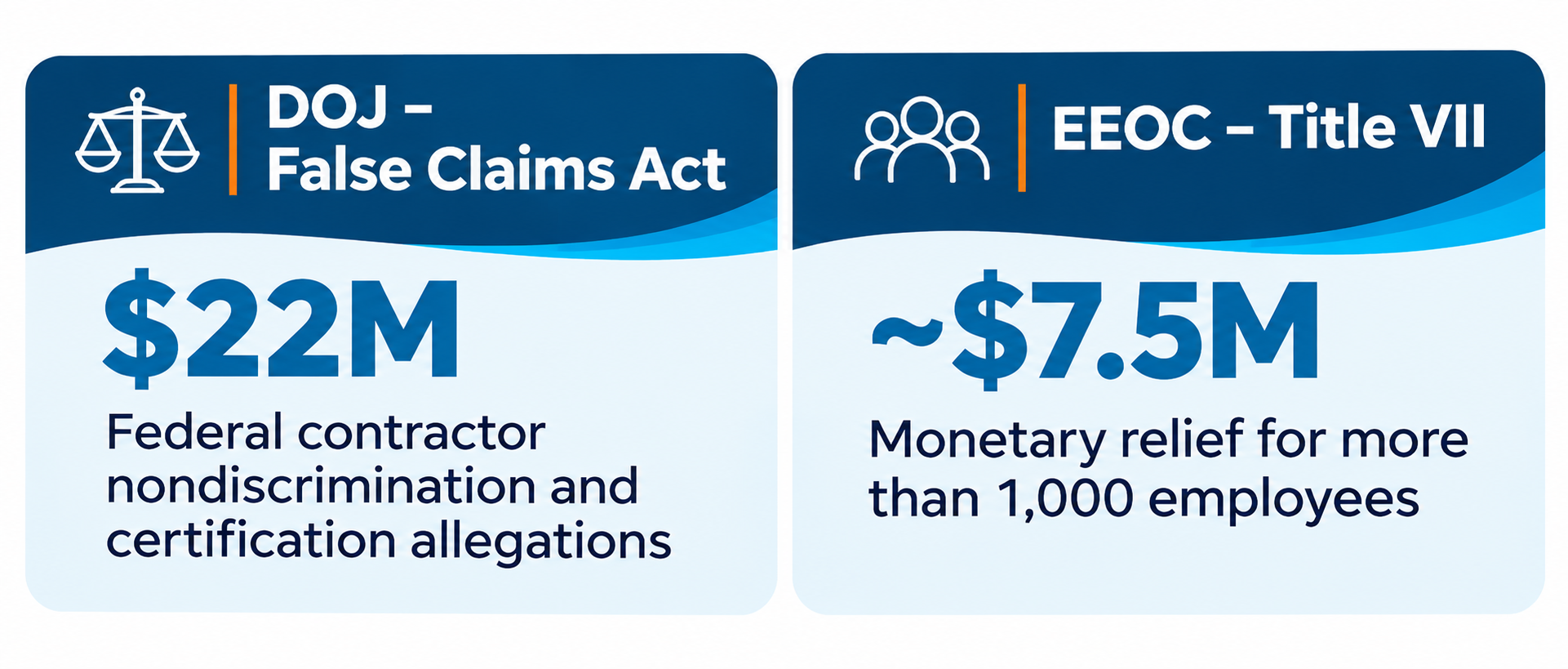 The DOJ alleged that certain compensation decisions were adjusted based on race. The EEOC separately resolved allegations of race discrimination in performance assessments, bonuses, and other compensation decisions. The EEOC agreement also includes ongoing compliance obligations and review provisions.
This illustrates how a single set of employment practices can attract scrutiny under more than one enforcement framework.
Part I takeaway: Federal contractors should evaluate not only whether they have nondiscrimination policies, but whether their actual employment decisions, management incentives, and federal contract certifications are consistent with those policies.
At HR Unlimited Inc., we help federal contractors and employers navigate complex compliance requirements while building stronger, more inclusive workplaces. If you’re ready to strengthen your compliance and equity efforts, contact us today to learn how we can support your EEO and non-discrimination goals.