

A recent court decision involving Starbucks offers an important lesson for federal contractors navigating today’s DEI scrutiny: even in a politically charged environment, courts still require specific evidence of actual harm — not assumptions, headlines, or generalized allegations.
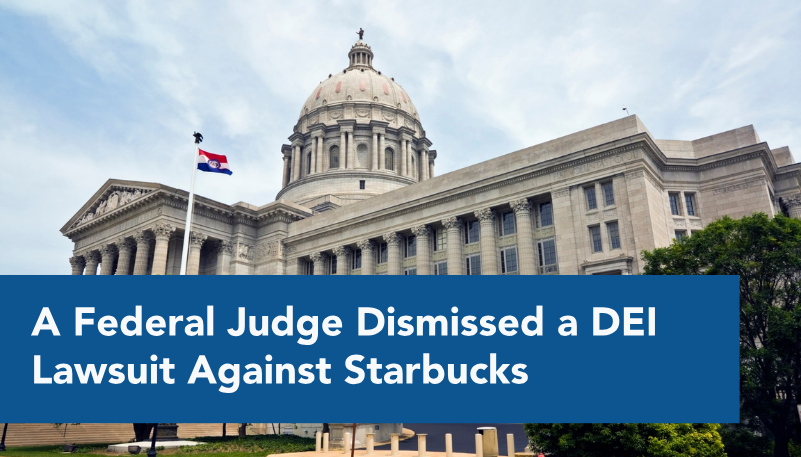
In the case, Missouri’s attorney general sued Starbucks, arguing that the company’s diversity, equity, and inclusion (DEI) initiatives unlawfully advantaged certain employees and applicants based on race, gender, and other protected characteristics. But the federal judge dismissed the lawsuit, finding the state’s allegations were too vague and failed to show actual, concrete injury to even a single Missouri resident.
For federal contractors, the ruling is not a “free pass” for DEI. Instead, it is a roadmap for how to structure programs, so they are both lawful and defensible if challenged.
Why the Judge Dismissed the Starbucks Case
The court’s dismissal was not a ruling that DEI programs are always lawful. The decision turned on a threshold legal requirement: standing.
To bring a case in federal court, the plaintiff must show:
- an actual injury,
- that is concrete and particularized,
- and tied to the challenged conduct.
Here, the judge concluded Missouri did not provide evidence that Starbucks’s DEI practices caused actual harm to even one person. The state “left to the imagination the actual enforcement and implementation” of the policies.
This matters because it reinforces a key principle:
DEI programs are not automatically illegal simply because they exist or are publicly stated.
However, the judge’s reasoning also highlights the risk area: if a program can be shown to create race- or sex-based preferences in hiring, promotions, training access, or compensation, then the legal exposure becomes much more real.
What Made the Starbucks Allegations Legally Sensitive
Even though the case was dismissed, the complaint focused on practices that federal contractors should treat as high-risk, including:
1) Incentive pay tied to race or gender outcomes
The lawsuit alleged Starbucks gave executives pay boosts for hiring and retaining a certain number of employees based on race or gender.
2) Training and advancement targeted by protected status
The lawsuit also alleged Starbucks gave more training and advancement opportunities to employees with certain protected characteristics.
These are exactly the kinds of program features that, if implemented in a rigid or preferential way, can trigger claims under:
- Title VII of the Civil Rights Act of 1964
- state human rights laws
- and, for federal contractors, new certification risk in the EO 14173 era.
What Federal Contractors Can Learn (Especially Under EO 14173)
Federal contractors are now operating under an environment where:
- DEI programs are politically targeted,
- enforcement is inconsistent,
- and allegations are increasingly used as leverage—even when weak.
The Starbucks case teaches three major lessons:
Lesson 1 — Courts still require proof, but investigations don’t
Even if a lawsuit is dismissed for vague evidence, an employer may still face:
- subpoenas,
- investigative requests,
- contract compliance scrutiny,
- reputational damage,
- and costly legal defense.
The goal is not just to “win the lawsuit.”
The goal is to prevent the allegation from becoming credible in the first place.
Lesson 2 — DEI language is not the main risk – implementation is
The judge noted Missouri did not show how Starbucks’s policies were actually enforced.
That is a warning for contractors:
A DEI statement alone rarely creates liability.
A preference-based practice does.
Lesson 3 — The highest-risk DEI programs are outcome-driven
If any part of your DEI initiative can be interpreted as:
- quotas,
- set-asides,
- race/sex-based selection,
- or “advantage” in hiring or promotion,
Then your risk increases dramatically—especially if tied to compensation or performance ratings.
Best Practices: How to Maintain a Lawful DEI Program (and Avoid False Allegations)
Here are the best practices federal contractors should implement now.
1) Make “merit-based” the anchor of every DEI program
A compliant DEI program should be framed as:
- equal opportunity,
- barrier removal,
- fairness and consistency,
- and job-related selection.
What to say in policy language:
Employment decisions are based on merit, qualifications, and business needs. We do not use quotas or employment preferences based on protected characteristics.
This single paragraph reduces risk dramatically.
2) Never tie incentives to protected-class outcomes
This is one of the most legally sensitive areas.
Instead of:
- “Increase women in leadership by X%”
- “Executive bonus tied to race/gender representation”
Use:
- “Executive bonus tied to lawful recruitment process improvements”
- “Executive bonus tied to reducing time-to-fill”
- “Executive bonus tied to expanding qualified applicant pools”
- “Executive bonus tied to completing structured interview training”
- “Executive bonus tied to retention improvement across all employees”
3) Ensure training and development programs are open and neutral
A safe model is:
- Training is open to all employees
- Selection is based on job-related criteria (performance, readiness, role)
- Outreach encourages participation broadly
- Selection decisions are documented
If you run an affinity-based mentorship program, the safest structure is:
- Open enrollment to everyone, and
- No exclusive advancement track tied to protected status.
4) Keep your DEI goals focused on process, not protected-class outcomes
The most defensible “DEI goals” are process goals, such as:
- Standardizing interview scoring
- Removing degree requirements where not job-related
- Validating selection tests
- Auditing promotion decisions for consistency
- Ensuring accommodation processes are responsive
- Training managers on anti-harassment and retaliation
5) Document the “business purpose” of every DEI initiative
A strong DEI program has a written justification that connects to:
- Reducing turnover
- Expanding recruitment reach
- Improving employee engagement
- Improving management capability
- Compliance with Title VII / ADA / ADEA
- Risk reduction and complaint prevention
This is especially important if a contractor later must defend its program against a politically motivated allegation.
6) Conduct a DEI legal-risk audit at least annually
Federal contractors should review:
- Policies,
- Job postings,
- Training programs,
- Scholarships,
- Internships,
- Leadership programs,
- Performance metrics,
- Executive incentives,
- ERG activities,
- Supplier diversity programs.
The audit should flag any program element that could be interpreted as:
- Preference,
- Exclusion,
- Or a quota.
7) Use neutral language in public statements
The Starbucks case began as a political challenge to broad DEI messaging.
Federal contractors should keep public-facing language:
- Professional
- Legally grounded
- Consistent with equal opportunity principles
- Not framed as “race-based correction”
- Not framed as “outcome entitlement”
8) Prepare for the “false allegation” playbook
Even if a claim lacks evidence, federal contractors should be prepared to respond quickly with:
- Clear written policies
- Training completion records
- Selection documentation
- Consistent scoring and interview notes
- Proof that decisions were job-related
This is how you defeat vague allegations early.
A Simple “DEI Compliance Checklist” for Federal Contractors
If you want a DEI program that is lawful and defensible under Title VII and EO 14173-era scrutiny, your program should be able to answer “YES” to the following:
- Are all employment decisions based on job-related qualifications?
- Are training and advancement programs open to all employees?
- Are incentives tied to lawful process improvements (not protected-class outcomes)?
- Are hiring and promotion decisions documented with neutral criteria?
- Are managers trained on equal opportunity, harassment, and retaliation?
- Do we audit for consistency and remove barriers without using preferences?
- Can we prove decisions were merit-based if challenged?
Final Takeaway: The Starbucks Decision Is Not “Pro-DEI”, It’s Pro-Evidence
The court did not bless DEI programs broadly. It simply reaffirmed that claims must be supported by concrete facts, not assumptions.
For federal contractors, the best strategy is not to abandon DEI or to make it performative. The best strategy is to operate a program that is:
- Lawful
- Merit-based
- Process-driven
- Documented
- And defensible
That is how you protect your workforce, protect your contracts, and reduce exposure to both discrimination claims and politically motivated allegations.